“The universe is not indifferent. I have the receipts.”
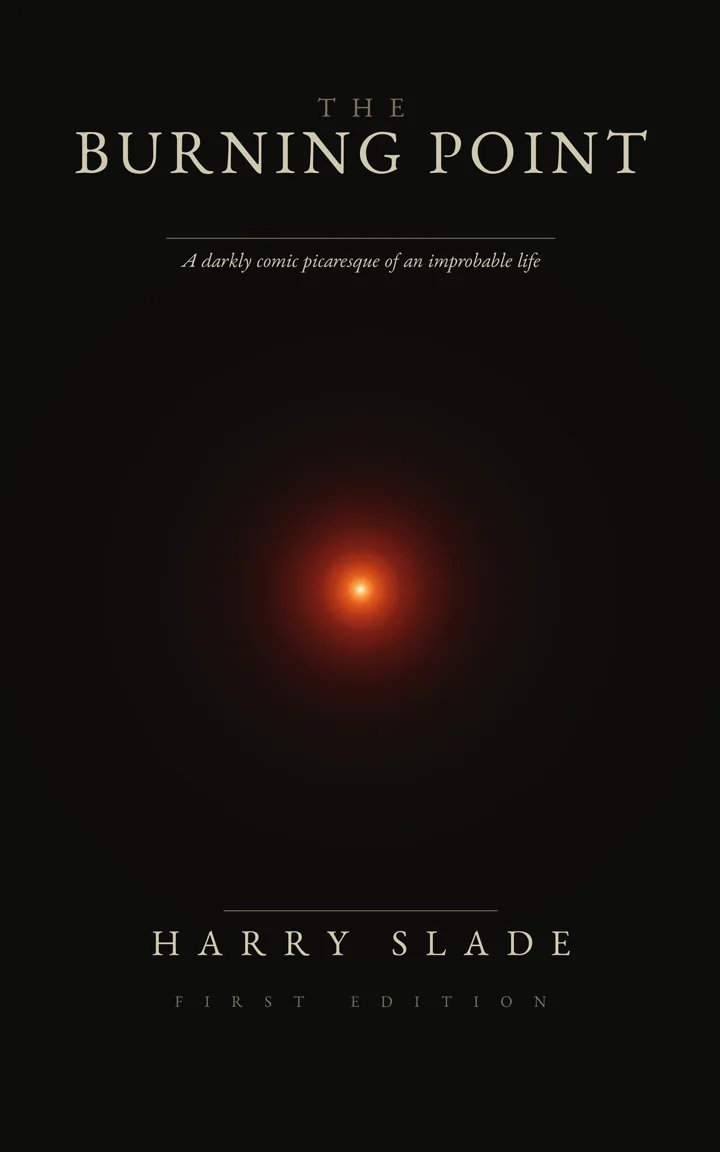
First Edition — available now
Order on Amazon“The universe is not indifferent. I have the receipts.”
First Edition — available now
Order on AmazonI thoroughly enjoyed The Burning Point. From the opening chapters I found myself completely drawn into Harry Slade’s extraordinary life story and the remarkable journey he has travelled.
There were moments when I was genuinely shocked by the lows – the hardship, betrayal, loss and setbacks he experienced – and at times it was difficult to imagine how one person could endure so much. I was also particularly saddened by the situation surrounding his relationship with his daughter. That part of his story stayed with me and added another deeply personal and emotional dimension to the book.
Yet these darker moments make the highs all the more rewarding. I found myself genuinely pleased for him when fortune changed, opportunities appeared and life finally offered some of the happiness and success he had worked so hard to achieve.
What particularly impressed me was the honesty of the book. Harry does not appear to shy away from his mistakes or try to present himself as perfect. His story is told with humour, wit and a refreshing directness, which makes some of the unbelievable episodes feel even more real. There are also unexpected moments of humour throughout, sometimes appearing just when the story is at its darkest.
For me, this is much more than a simple rags-to-riches story. It is about resilience, determination, survival, reinvention and ultimately discovering what really matters in life.
I finished the book feeling that I had travelled through the many highs and considerable lows alongside him. I was shocked by some of what he endured, saddened by the more personal losses and family difficulties, but also genuinely happy for him during the many moments when life took a turn for the better.
Shocking in places, very funny in others, deeply moving at times and ultimately uplifting. A fascinating and memorable read that I would happily recommend.
This author’s pithy and candid life story made me cry at the personal traumas and losses he suffered but then I laughed at the moments he described how fortune saved him from worse fates. And he inspires with his stories of reinvention and of finding unconditional love at the end of his long and challenging life journey. He narrates all in a likable roguish manner. A wonderful read.
This book is the telling of a driven man’s life through all the triumphs and setbacks life could throw at him and he didn’t falter in his belief of himself. Mr Harry Slade has a way of delivering sentences that makes you stop and go back to read over again to imprint on your mind for future reference. A remarkable book a fascinating life story. Highly recommend.
Harry Slade’s novel, written in the style of a memoir, is particularly dark, irreverent, and filled with unbelievable yet true episodes. The book does not merely recount events; it presents life as a succession of colorful adventures in which personality, chance, and survival matter more than a conventional plot.
Highly recommend! Very funny when you least expect it, really couldn’t put it down.
This book is amazing, a very easy reading I couldn’t stop reading. This is a colourful story of a life told intimately and forensically from the inside - a life fractured by abandonment, survival, divorce and treachery and rebuilt each time to find fortune, adventure and love. An incredible journey which could have been written by Homer himself.
A fascinating life story told with acerbic wit in the manner of Martin Amis’ Money.
A highly enjoyable read. Harry Slade's extraordinary life is wryly told in a coolly conversational style, without sentiment and with objectivity. Vicissitudes both personal and business are seen from the inside of a life which, from the outside, most would envy. Not just 'rags to riches', but all points in between, betrayal, trust, persecution, determination, loss and finally a philosophical acceptance of the parts played by Harry, Lady Luck and Miss Adventure.
Some lives are so extraordinary they read like fiction. The Burning Point by Harry Slade is one of them.
From a grim Yorkshire childhood to building businesses and fortunes, Slade’s journey is remarkable. But this is more than a conventional rags-to-riches story. Beneath the humour and glamour is an honest account of betrayal, survival, ambition and the costs of success.
What makes the book particularly engaging is Slade’s voice: irreverent, self-deprecating and refreshingly candid. He is willing to expose his own mistakes as readily as he challenges others.
The Burning Point is ultimately a story of resilience, but also of discovering what truly matters when wealth and achievement are no longer enough. Funny, candid and unexpectedly moving, it is a fascinating account of an extraordinary life.
A powerful, honest and unforgettable read. The Burning Point is more than a story of success—it’s about survival, resilience, loss, love and the real price of ambition. Harry Slade’s journey is raw, darkly funny and deeply human. A truly inspiring book that keeps you thinking long after you finish it. Definitely worth reading.
A magnetic journey! I'm warning you now that, once you start, you'll have to readjust your priorities because the reading will captivate you, story after story. Highly recommended, this one’s worth it.
Burning Point was a fantastic read. I quickly became invested in the characters and loved how the story unfolded. The writing is engaging and easy to follow, making it difficult to put the book down. It has the perfect balance of emotion, suspense and unexpected moments. I would definitely recommend it, and I’m already looking forward to the author’s next book.
Introduction
burning point (n.) the point where scattered light is gathered until it burns clean through
Born in a Yorkshire slum in 1955 and abandoned at three years old, the seventh child of a family that could feed none of them, Harry Slade escaped a bleak reality at seventeen with nothing but fear, a dangerous intelligence, and a teacher’s promise: that if he could concentrate his feral energy like a magnifying glass in sunlight he could burn through anything in his way.
He believed it. Out of the soot and the fists, Slade built businesses across three continents, made and lost fortunes, dined with the famous, and raised a second life in Monaco, Tuscany and Brazil after the first was taken apart by litigation, divorce and betrayal — surviving each brush with ruin and death by a margin so precise he came to suspect the universe of running a very personal account on him. And, in his seventh decade, he found unconditional love.
But beneath the glamour and the gallows humour runs a darker confession: the violence that survival demanded, in the slum and the boardroom alike; the things he did, and the things he left out; and the one wall he could never burn through. And he narrates the whole circus in a self-lacerating voice, as funny as it is unsparing and gloriously rude — about the institutions that earn it, and hardest of all about himself — this is the reckoning of a man who got everything he chased, and tells you, at last, what it cost.
The Burning Point is the account of that improbable journey. A literary picaresque describing a darkly comic panorama of a life punctuated by an unshakeable refusal to accept defeat.
You may not envy the journey. You will not forget the man who made it.
Prologue
“The universe is not indifferent. I have the receipts.”
There is a comforting modern idea that the universe doesn’t care about you, that it’s all just rock and gas and physics grinding away, with no opinion of you whatsoever in its cold, unreasonable silence. It is meant to settle the nerves. It has never once worked on mine, because I have seventy years of evidence to the contrary, and the evidence says it cares about me very much, very personally, and with a sense of timing I would describe, were it a colleague, as unprofessional.
Allow me to enter a few exhibits.
I camped at the edge of Iceland’s largest glacier with my son and ten of his schoolfriends. We struck the tents, drove away, and a few weeks later the universe detonated a volcano directly beneath the spot, removing the road, the bridges, and the ground we had slept on. A few weeks. The universe never misses. It merely likes a run-up.
An ex-fighter pilot flew me round the bottom of the world in his little aeroplane one bright morning, and a fortnight later that same aeroplane went into the side of a mountain with somebody else sitting in my seat. The universe’s tap on my shoulder.
I sold a large property one Friday, and the following Monday, Black Monday, the entire money of the Western world set itself on fire. I had got out, by the seat of my jodhpurs - the universe’s customary margin.
Men in fine tailoring arrived on my doorstep at six o’clock one morning to freeze everything I owned. The universe’s notion of a lie-in. And then, the flourish, the touch that made me suspect genuine cosmic artistry: a four-year investigation into my entire existence, by the taxman, the letter arriving, gift-wrapped with menacing affection, on my birthday!
Now. A sensible man, shown this pattern early, files quietly for the easy life. I did the opposite, every single time, with titanic energy and at staggering expense. And I should like the record to show that my attempts to set things right, whatever else may be said of them, were never less than operatic. I made fortunes; they were redistributed by recessions, lawyers in better suits than mine, divorce – the universe has a long list. I fought every wall it set in front of me, found the one weak spot, concentrated everything I had onto it, burned a hole clean through, and climbed out the other side — only to find, with a regularity that ought to have taught me something a great deal sooner, another wall, freshly built, the cement still wet. I felt like Sisyphus, except that Sisyphus had the dignity of a single rock and at least knew where he stood. I held a whole portfolio of rocks, internationally diversified, and a firm conviction, renewed each morning over coffee, that this would be the year I got the lot of them to the top.
Which brings us to the question this entire book is, underneath the jokes, trying to answer, and which I’ll hand you now so we can both keep half an eye on it: who is doing this, and why, and what do they want from me in return? Because one piece of luck is luck, and two is coincidence, but a whole life of timing this exquisite — saved at the last possible moment, again and again, by a margin of hours — is not luck at all. It is management. Somebody, somewhere, has been running my account, and running it with flair. I have spent seventy years trying to catch them at it, and I have failed, and it is the one deal of my life I was never able to close.
And here, I’ll warn you, is the part the universe keeps back for the very end of the act, the way the truly good comedians always do. All that colourful, futile, magnificent fixing — every company, every fortune, every wall burned through by a furious man with a magnifying glass — turns out to have been one thing wearing a hundred disguises: a man trying, by the only means he had, to reach the people on the far side of the wall. It let me save the houses, the money, my own ridiculous skin, over and over, with insulting ease. It rescued, tirelessly, everything that did not matter. And the one thing I’d have handed it all straight back to keep, it let me lose at leisure, and offered, that once, no margin of hours at all.
But that’s the end, and we have not earned the end. The end, like everything else in this book, has to be paid for in full, and the meter starts where I started.
It starts, as these things do, in the soot. 1955. Hunslet — a place that sounds like something heavy landing on your foot, and is much more painful. Mind your step on the way down; it’s a fair drop before it turns into a climb. And keep that question somewhere you can feel it, a stone in the pocket: who’s doing this, and what do they want? I’ll ask you again at the end, when we’ve both seen the evidence. I should be very interested to know whether your answer comes out anything like mine.
Excerpts
Rags to riches: the oldest con on the shelf, and the most reliable. We love it because it tells us money is a moral reward – the self as a going concern: work hard, deserve it, collect at the desk - and it quietly bins the part where half of any fortune is luck, timing, and being in the right gutter on the morning it rained. It flatters the winner into thinking he’s virtuous and the loser into thinking he’s idle, which is precisely why the winners never stop telling it. I should know. I’m a winner, more or less, and I’m about to tell you one.
And it was rough in a way that doesn’t carry to people who grew up where it wasn’t. Violence in Hunslet wasn’t an event. It was currency. It was the background hum, the mother tongue. Everyone spoke it, fluently, from the cradle. You learned to fight because the alternative was learning to be hit. My two older brothers, Mac and Joe, were hard lads with reputations, the toughest going, not to be messed with, and you’d think that would buy the baby of the family some peace. It bought him the opposite. It bought him a queue.
Joe wasn’t a violent man, understand. Joe was the gentlest of us until you crossed a certain line: fairness, respect, the few things he’d planted his flag on, and then something that had been packed down in him for years came up all at once and went off in your face like a furnace door swinging open. He’s the one who taught me the whole of my philosophy on the subject, and it’s served me in boardrooms since as well as it ever did in the road: avoid it if you possibly can; but if you can’t, if you’re cornered and it’s you or them, then take the surprise, hit first, and hit hard enough that there isn’t a second exchange. And the other half, the half people forget, that the outcome is never certain. One slip, one fluke, one unlucky angle, and the hardest man in the street goes down to the softest. I’ve watched that happen at every weight class life offers. The favourite is just the one the odds like. The odds don’t throw the punch.
And these men did sixteen-hour doubles, six and seven days the week. And every Friday night they took the wage to the pub and drank it down into oblivion, drank until the week and the works and the whole grinding fact of themselves went dark for a few hours. I watched them do it, week on week, and it went into me cold and clear and permanent, the truest sentence the place ever taught me: to exist like this is to consume yourself. To drink yourself dry
Still, the late seventies were a giddy, happy blur, head spinning, business growing, and the first sweet fruit of it arriving in the form of my magnificent Jensen Interceptor SP III. Roman purple, buttery-smooth cream Connely leather, smelling of a tannery – just so you get the picture. Target one, met, in metal, with the V8 in it. I was so proud of that car. I was proud of it right up until the afternoon it burst into flames. I was sitting in traffic directly in front of the Garrick Theatre when the engine elected to combust externally, in full public view, to my towering humiliation, to the open delight of my passenger – the Swede – and to the entertainment of the entire theatre queue, who got a matinee they hadn’t paid for. There it is, reader, the whole of it in one scene: the boy from the Morris Minor, first target achieved, sitting in his trophy as it cremated itself merrily on the Charing Cross Road. Pride, I learned, publicly, in front of an audience, precedes a fall. It also, on that occasion, precedes a fire brigade. The gods, it seemed, were really paying attention, watched by a queue.
Most of that collection went the way of most things in a divorce — into the fire, divided and itemised and lost to the settlement, the lawyers, the whole scorched-earth arithmetic of two people undoing a shared life. But I carried some of it out of the ashes, a canvas here, a canvas there, and those survivors hang around me still, and they are the truest mirror I own. Not the suits, not the clubs, not one of the deals — the paintings. Because everything else from those gleaming years has scattered or died or been sold to strangers, but a beautiful thing, well chosen, simply carries on being beautiful, serenely indifferent to your divorces and your recessions and your slow rearrangement into an old man at a window. That, it turns out, is the part that endures.
The air went. My chest closed like a fist. My heart began to do something frantic and arrhythmic, a drummer falling down stairs. My mouth dried; my palms ran. And then the worst of it, the thing I still can’t say cleanly: a great peeling sense of coming loose from my own life, as though I were watching it on a television set across the room, and the set had just cracked from corner to corner, and the picture went on regardless behind the crack. The chandeliers swam. The chief executive’s face came at me down a lengthening tunnel, his mouth moving, no sound arriving. I excused myself. I walked to the bathroom with the careful dignity of a man crossing the deck of a ship he knows is going down, and I stood at the mirror and checked, with my hands on the cold porcelain, that I was still in there.
It was not a short ring. Men with the law on their side do not use a short ring; a short ring implies you might reasonably say no. It was the bell, held down with a sense of purpose, outside the electric gates, at six exactly, with the particular insolence of people who have read the order and know that the gate and the door is, as of about an hour ago, more theirs than mine. I opened the gate and came down to the door in a dressing gown. Through the glass I could see coats, good coats, which was the first wrongness, because the menace I’d been raised on wore donkey jackets or leather jackets and at least had the decency to look the part. These looked like men on their way to a decent lunch, or a funeral. There were several of them, and one in particular, a supervising solicitor appointed by the court to lend the whole invasion a veneer of fairness, who wore the rodent expression of an undertaker who enjoys his work but knows it isn’t the done thing to show it.
They tried to bury me. Fair enough. It’s the going rate for getting above your station, and they did it properly, by the book, with lawyers for shovels, a dawn raid for a funeral and a freezing order where the headstone should go. Their one mistake was horticultural. You bury a corpse. You plant a seed. Nobody thought to check which they had.
There’s an old line — Confucius gets the credit, and may even deserve it — that before you set out to harm a man you should dig two graves. The first is for him. The second is for yourself, because you will most likely be destroyed by your own malice, or by the consequences it sets running, which come back to you over time with the cold reliability of physics: every force, an equal and opposite, no exceptions filed.
Here is the thing nobody tells you, and it took me thirty-five years and a near-death experience in a London hotel lavatory to learn it: the gap between who you are and who you’re pretending to be is not a quirk. It is a wound, and it leaks. Picture a fried egg, if you’ll let me be vulgar about the soul for a second. The white is who you actually are. The yolk is who you’re straining to be. Keep the yolk inside the white and you have breakfast. Let it run, let the two come apart, and you have a mess on the plate and a body that has quietly decided it is under attack. Stay under attack long enough — years, decades, a whole driven life — and the stress chemistry stops being weather and becomes climate. It goes to work on the vessels, the immunity, the brain. It ages you from the inside like damp in a wall.
I drove away rearranged. Here was a man who could move nothing but his head, running one of the most complex and savage businesses on earth, and he had reduced his entire existence to a single burning point and lived there, on purpose, every day.
We reversed out of that cave with a slowness I have never since equalled, Jack’s small hand in mine, my eyes on the dark, the growl following us to the mouth and no further, and we stood in the wet green dawn with our hearts going, and I learned that fear — real fear, the clean animal kind that has nothing to do with offers at the Ritz — is the most purifying substance on earth. I had not thought about Kuck, or Etoile, or who I was pretending to be, for the entire duration of that growl. The jaguar had reduced me, mercifully, to one thing: a father getting his son out of a jaguar’s cave. The simplest and best version of me I have ever been.
The room was beige in the way that only official rooms achieve, a beige that seems less a colour than a sedative. There was a table, unassuming, and water in a jug nobody drank, and my accountant beside me with a lever-arch file for every year of my adult life, and across from us the inspector — courteous, unhurried, with the soft remorseless manner of a man who has all the time in the world because he is, in the relevant sense, immortal. He represented an institution that cannot die, cannot tire, and cannot be sued for wasting your one finite life. I represented a man with a mortgage, a pulse, and a calendar that was, unlike his, running out. It is not a meeting between equals. It is a man being interviewed by a glacier.
What I left out was the shape of the bargain on offer from these rescue funds, because the bargain is the lesson. Rescue capital is not rescue. It is a transfer of ownership conducted under anaesthetic. The terms would keep the ships afloat and the investors technically alive, at the price of signing the entire upside of any recovery over to the rescuers — so that if the world ended, we lost everything, and if the world recovered, they kept it. Heads they win, tails we lose, the oldest asymmetry in finance, now wearing a life jacket and calling itself salvation. The dilemma was constant and exquisite: take the vulture’s terms and survive, gutted, a tenant in the company you’d built — or refuse them, keep your dignity and your upside intact, and sink with both. I have never found dignity to be worth a great deal at the bottom of the sea.
Tom Wolfe set down the terrible discovery a man makes about his own father sooner or later: that the towering Protector who once kept the roof on the sky was never a god at all, but a boy — a frightened boy much like himself — who had grown up, had a child, and out of duty and perhaps love taken on a role called Being a Father, improvising a lid over all the chaos and catastrophe of life so that the child would have something mythic to hold on to. I made that discovery about my own father late, watching a ninety-odd-year-old man who had laid telephone cable across the Japanese front lines and come home sealed shut, and understanding at last that the silence I’d taken for strength had been a boy holding a lid down with both hands.
It begins, always, with the frogs. You want one good company, so you kiss a great many. You sit in rooms full of men selling you the best years of their lives at a markup, and most of them are frogs and stay frogs no matter how you pucker up. You learn to read them fast — the ones polishing a turd to a high shine, the ones whose numbers have been combed over so carefully you can see the teeth marks, the ones who’ve quietly stopped investing in the thing two years ago and are now selling you the momentum of a coasting car with the engine off. You kiss and you kiss and your lips go numb and somewhere in the procession a frog looks, in a certain light, after a good lunch, like a prince. And that, friend, is the most dangerous moment of the entire enterprise, because the prince is the one you stop interrogating.
Hunslet was worse than I let on. I gave you the version with the maroon blazer and the three buses and the rough-but-formative grain of the place, the version that plays as character-building, and all of it was true and none of it was the whole truth. The whole truth is that the place was a machine for the manufacture of desperate men, and desperation, observed close up and from the inside, does not ennoble people. It deforms them. It traumatises them young and then hands them, fully traumatised, to their own children, generation after generation, a relay race of damage run with no finish line in sight.
The art of surviving it is the art of making yourself a smaller, harder target — and now and again, when quiet won’t do it, of taking the loudest threat and removing it from the board so comprehensively, so memorably, that the others recalculate and leave you alone. You do not win that war by being reasonable. You win it once, brutally, in public, and then you bank the silence.
I did not raise my voice. I have never found that voices need raising; it’s a confession of weakness, raising your voice, an admission that the words alone won’t carry the freight. I asked Hugo if he’d step outside with me for a moment. Just a word. And in the corridor, away from the buyers and the lawyers and the careful theatre of the thing, I explained the position to him in terms I had first worked out at the age of twelve with a glass jug in my hand, translated now into the dialect of men who lunch. We would go back in, I said. And he would sign the deal exactly as it stood, not a penny altered. Or I would walk back in, cancel the sale in front of everyone, and fire him from the board on the spot, there, in the room, so that the last public act of his distinguished tenure would be his removal. His choice entirely. I genuinely didn’t mind which. That was the part, I think, that persuaded him — that I genuinely didn’t mind which, that I had already made my peace with blowing up my own deal to deny him his squeeze. The desperate are frightening to the comfortable precisely because the comfortable have so much more to lose.
The lesson Hunslet teaches and the lesson the boardroom teaches are the identical lesson in different tailoring: decide what you are actually prepared to do, make the other man believe it without theatrics, and then — this is the part the MBAs leave out — actually be prepared to do it. The bluff only works if it isn’t one.
Never meet your heroes, the saying goes, and it is sound advice, but it misses the deeper and sadder thing, which is not that they’re disappointing but why. These were Icarus, all of them, every one — given wax wings and a glorious morning and the whole sky, and they flew at the sun because that is what the wings are for, and so many of them came down early, burned out, fell into the sea while the crowd was still cheering, dead or hollow or both before forty. I watched a number of them do it. The light that dazzles the stadium is the same light that consumes the man holding it; there is only the one source, and it does not distinguish between illuminating you and burning you down. I stopped envying the famous quite early. It is one of the few pieces of wisdom I came by cheaply, and I have tried to be grateful for it, since so little else was.
Their favourite phrase, the one that still lifts the hair on my neck, was skin in the game. They would say it to me — to me, and to men like me — across those desks. Did I have enough skin in the game. We required, they’d murmur, to see real skin in the game. And I would sit there, having mortgaged my house, my marriage, my sleep, my health and a painful share of my actual internal organs into the thing they were proposing to grace with a fraction of their fund’s spare change, and I would listen to a man who had risked nothing more dangerous in his life than a strong opinion in a Monday meeting lecture me on skin. They had no skin in any game. They had other people’s skin in every game, which is a different commodity entirely and trades, morally, at an enormous discount.
The tragedy of the human condition, examined the way I have been forced to examine it — close up, from the inside, with frequency and intimacy, in the boardrooms and the back streets and the lavish dying years of marriages and companies — is a nihilistic tragicomedy. It is, more or less, Macbeth’s verdict: a tale full of sound and fury, told by an idiot, signifying, on a cold reading, nothing. It is also, I’m aware, more or less a description of this book, dear reader, which has been precisely that — sound, fury, an idiot narrating, the whole picaresque clatter of a life lived at the top of its voice. I won’t insult you by pretending otherwise.
Every explorer who ever crossed an ocean took the soft option. The longest, hardest, worst-charted voyage on earth is the one straight down into your own heart. There’s no view, no applause, no frequent-flyer points, and a fair chance you won’t much like who’s waiting at the bottom. Most people never book the trip. I left mine until the last chapter.
Swipe, or use the arrows
About Harry Slade
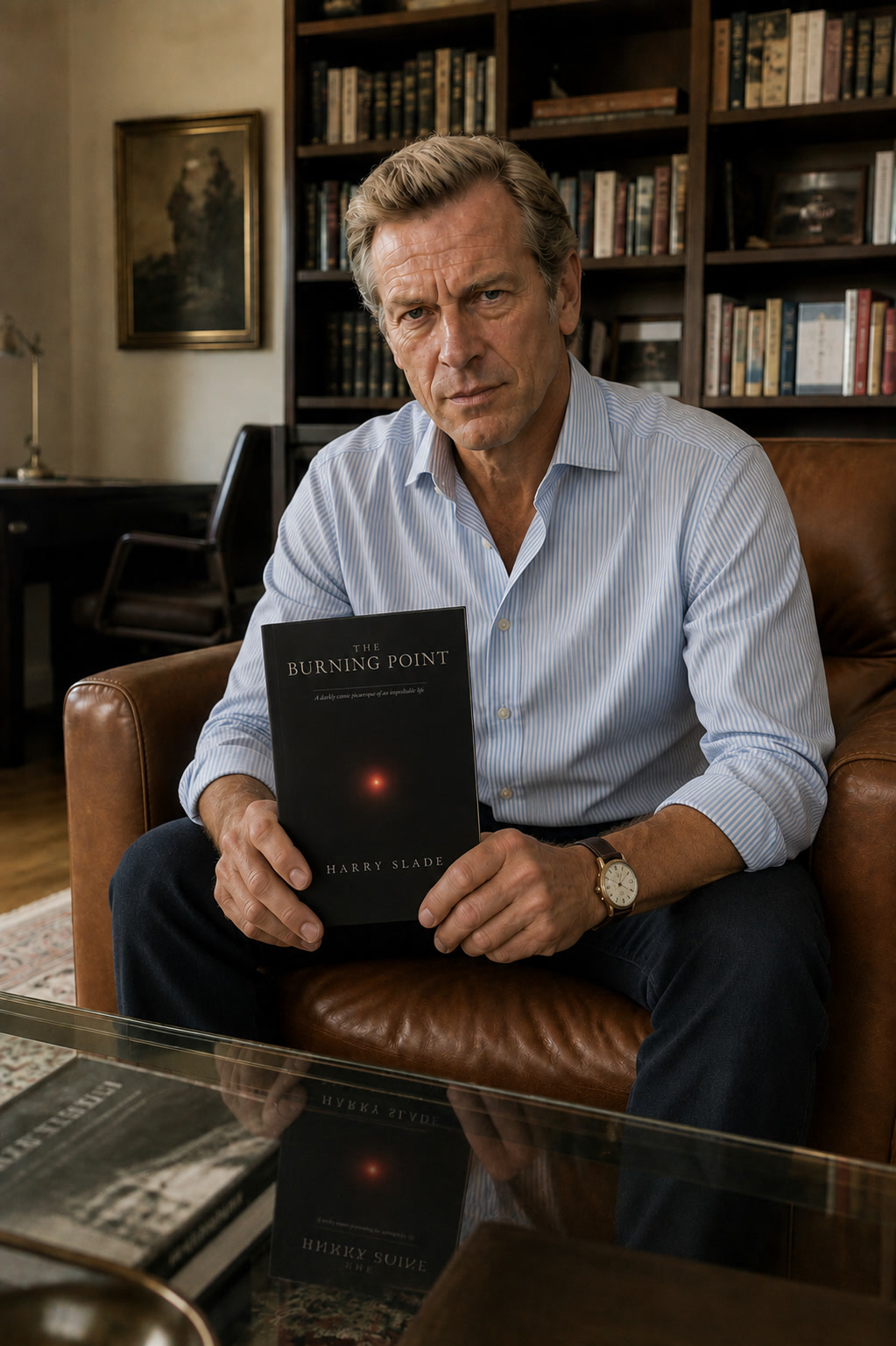
The author was born in 1955 in Yorkshire, England. He studied contemporary art at Leeds Art University and built a career over five decades in advertising, information technology, private equity, property and shipping. He bought and sold over thirty companies and ran groups across three continents, going on to advise multinational corporations on mergers and acquisitions, strategic development, restructuring and finance.
Today Harry Slade writes from his homes in Monaco, Italy and Brazil. His writing has been inspired by authors such as Martin Amis, John Fowles and Christopher Hitchens.
A darkly comic picaresque of an improbable life.
First Edition — Available now
In paperback, ebook, and audiobook.
Audiobook
Listen on Spotify.